
Spoiler Warning: Spoilers for The Odyssey ahead!
Back in 2023, I was utterly floored by Christopher Nolan’s Oppenheimer. Three years later, I still think it’s his best film to date. So, when it was first revealed not long after that film’s release that Nolan’s next film would be an adaptation of The Odyssey, I immediately had high expectations. And I’m glad to say that those expectations were met, if not slightly exceeded.
Christopher Nolan’s The Odyssey is sprawling and massive in every sense of the words. It’s a very, very smart adaptation of Homer’s ancient Greek epic poem, capitalizing on the most important elements of the original work while rearranging others to better deliver the story to modern audiences. If Oppenheimer is Nolan at his best, then The Odyssey is an extremely close second.
The Odyssey follows Odysseus, the Greek king of Ithica, as he embarks on a perilous journey to return home following the Trojan War. During their travels, Odysseus and his men encounter a number of hurdles and mythical creatures, including the monstrous cyclops, the mysterious witch Circe, the underworld itself, and plenty of rough seas. Meanwhile, back in Ithica, all is not well; the vacant throne leaves Odysseus’s house vulnerable to dozens of greedy suitors vying for the hand of his wife, Penelope. Oydsseus’s son, Telemachus, thus embarks on his own journey to find his father. Ultimately, by his own will or that of the gods, Odysseus must return home to save his land and redeem the honor his people lost during the Trojan War.

Matt Damon as Odysseus and Zendaya as Athena
Nolan didn’t necessarily set out to reinvent the wheel with the story of The Odyssey, nor should he have. If you’ve read the original Greek epic poem, or even if you have cursory knowledge of the source material, you’ll know most, if not all of what happens here. The film is not without its fair share of deviations, but having read both The Iliad and The Odyssey earlier this year, I think most of the changes made help enhance the story rather than harm it.
For example, Nolan’s version of this story feels much better paced than the original. While I really enjoyed the Greek epic poem, I also felt it did get repetitive at certain points. There’s a lot of redundant exposition, with many sequences playing out in the manner of, “something happens, and then people talk about the thing that just happened.” This, of course, can be attributed to how storytelling worked back then (oral performances), but I don’t think translating that one-to-one would make for a great film in 2026. Ultimately, the way everything is rearranged and sequenced in this film suits Nolan’s storytelling strengths.
Perhaps my favorite change to the source material is how the Battle of Troy is portrayed. It’s in neither The Iliad nor The Odyssey, funnily enough, but it might very well be the best part of the film. The sequence of the Greek army actually infiltrating Troy via the Trojan horse is perfectly tense, and Odysseus’s Act Three monologue about how wrong they were for committing that act of subterfuge is equal parts beautiful and brutal.

Anne Hathaway as Penelope and Tom Holland as Telemachus
The power behind all of this is thanks in no small part to the actors bringing the characters to life. Everyone in this film gives it their all, and it shows. There’s not a single bad performance here. There are honestly too many actors to list, so if I’ve left anyone out, I promise, it’s not on purpose.
The Odyssey features an astonishing ensemble cast (like many of Nolan’s prior films), including Matt Damon as Odysseus, Anne Hathaway as Odysseus’s wife Penelope, Tom Holland as Odysseus’s son Telemachus, and Zendaya as Athena. And while Damon and Hathaway do their utmost to steal every scene they’re in, I think the more impressive standouts were John Leguizamo as Odysseus’s longtime faithful servant Eumaeus, Himesh Patel as Odysseus’s second-in-command Eurylochus, and Robert Pattinson as Antinous, one of the main suitors hoping to marry Penelope.
I found Damon’s performance to be quite similar to Cillian Murphy’s in Oppenheimer; while it may feel fairly one-note, it’s all the subtle things he does that ultimately add so much to every one of his scenes. He carries the character of Odysseus with stoic confidence, but also with noteworthy hints of doubt and grief. Hathaway, on the other hand, gives a much bigger, more emotive performance, allowing her to truly stand out in her authoritative role as the Queen of Ithaca. I’ve heard arguments that this might be her best performance yet, and while I don’t entirely agree with that, I can certainly understand the sentiment.
I liked Tom Holland as Telemachus—nice to see him outside of the Spider-Man tights for a change—but he’s definitely outshined by guys like Robert Pattinson and Jon Bernthal (as Menelaus, the King of Sparta), whom he shares most of his screentime with. Himesh Patel and John Leguizamo, on the other hand, were such pleasant surprises in this film, giving subtle yet emotional performances that added great depth to their scenes. Zendaya’s performance as the goddess Athena is limited but powerful, particularly given the big reveal involving her character toward the end of the film. Lupita Nyong’o also gives a similarly limited but elegant performance as Helen of Troy; her role in the story may seem fairly understated but is nonetheless impactful. Oh, and how could I forget about Samantha Morton as Circe. Holy smokes.

Samantha Morton as Circe
That’s actually a great segway for me to talk about the tone of this film.
Part of why I say this is a “smart” adaptation is because of how Nolan treats the source material tonally. On paper, The Odyssey mostly reads as a truly epic adventure, with Odysseus and his men encountering mythical monsters, chatting with the dead, and conversing directly with the gods themselves. And while much of that is preserved here, Nolan chose to mostly examine all of this through a more grounded and, at times, horrific lens, a choice that I think paid off in spades.
To that point, Samantha Morton’s scenes as Circe feel like they’re ripped straight out of a horror film, as we watch her mold Odysseus’s men into pigs in fairly graphic and grotesque detail. What makes it even crazier and more potent is that it was all done practically, using clay molds and animatronics that Morton could actually reshape while filming the scene. It just goes to show how effective Nolan’s filming methods are.
Speaking of which, working alongside Nolan are many returning collaborators, including cinematographer Hoyte van Hoytema, film editor Jennifer Lame, and composer Ludwig Göransson.
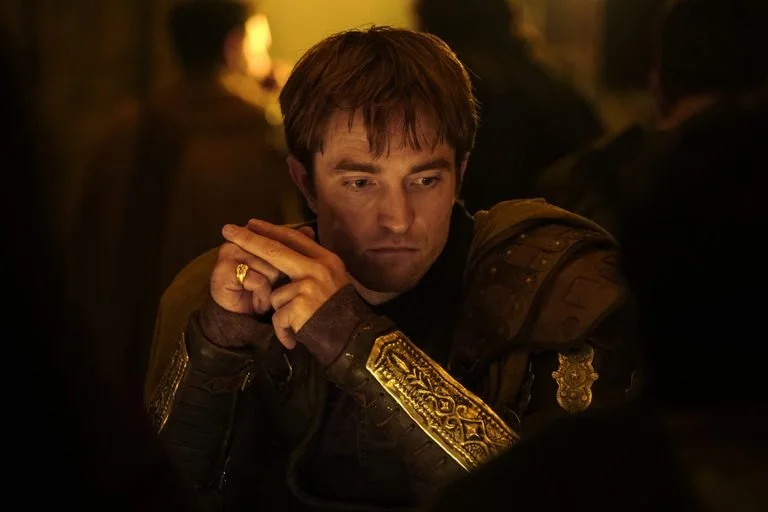
Robert Pattinson as Antinous
Let’s start with Ludwig Göransson, because I’m very biased toward this man’s music. It’s genuinely nuts how Göransson just writes killer film soundtracks for the fun of it, from Oppenheimer to Sinners to The Odyssey. That’s an insane track record of successful, pulse-pounding music, and that’s from only three of the most recent films he’s worked on. I think best part about his work on The Odyssey is that you can clearly hear subtle hints of inspiration from those two prior films.
And yes, I know everyone went kind of nuts that Travis Scott was in this movie and writing a song for it, and that was pretty funny on paper, but uh… “When I’m Home” actually slaps. Fitting, too, considering his song on the Tenet soundtrack also goes hard. Suffice it to say, though, I love the music in this film.
Similarly, I’m a massive fan of how the movie looks and how it was edited. Again, the way everything is sequenced from start to finish plays into much of what Nolan does well as a filmmaker, which is thanks largely to how it’s all edited. Film editor Jennifer Lame delivers yet another film editing masterclass with this one. It’s maybe not as silky smooth as Oppenheimer, but there’s clear intent behind every cut and scene shift, almost all of which helps enhance the story.
Some of the shots captured by cinematographer Hoyte van Hoytema just need to be seen to be believed. So much of this movie is downright breathtaking; there’s an early shot of Odysseus and his men sailing home that just floored me. And again, that Act Three monologue from Odysseus, interwoven with scenes from the Battle of Troy, is simply next level.

Benny Safdie as Agamemnon and Matt Damon as Odysseus
But while there’s much to love within The Odyssey, it does unfortunately suffer from a few of the old Nolan-isms, as one might call them.
I don’t think it’s any secret that dialogue in Nolan movies isn’t always perfect. Most of the time, it’s great, but sometimes it can be…overly explanatory. Case in point, the opening scenes of The Odyssey definitely have this problem. Characters talk to each other in a very expositional manner, like they’re just trying to get dialogue out for the sake of helping the audience understand the full context of the world and its history. And while yes, that’s helpful, there are certainly more creative ways to go about writing such material.
Also, the old Nolan sound mixing problems have returned. A lot of people had this problem with Oppenheimer—I didn’t think it was so bad there—but it’s definitely a more prevalent issue in The Odyssey, particularly in the cyclops scene. There’s a specific moment where the cyclops is speaking, and I felt like I was supposed to hear it, but I couldn’t make out a single word over its crying (holy shit, my ears). A couple scenes later, Odysseus’s men start talking, saying something along the lines of, “Oh, yes, it spoke. It’s the son of Poseidon, and he asked his father to seek vengeance against us.” I was sitting there like, “It really said all that?! Sure wish I could’ve heard any of it!”
I also think it’s worth noting that this film does touch on similar subject matter to Oppenheimer, particularly in its anti-war theming. And while I do love that, I think it was handled with more nuance and elegance in Oppenheimer. Yes, Odysseus’s monologue is amazing, but it’s also a very obvious moment where the movie kind of just states what it’s actually all about. It doesn’t make the message any weaker, and that scene itself works quite well in recontextualizing the whole movie, but given that we’ve seen Nolan discuss such things in a more gripping manner before, I don’t think it’s crazy to have expected a bit better.
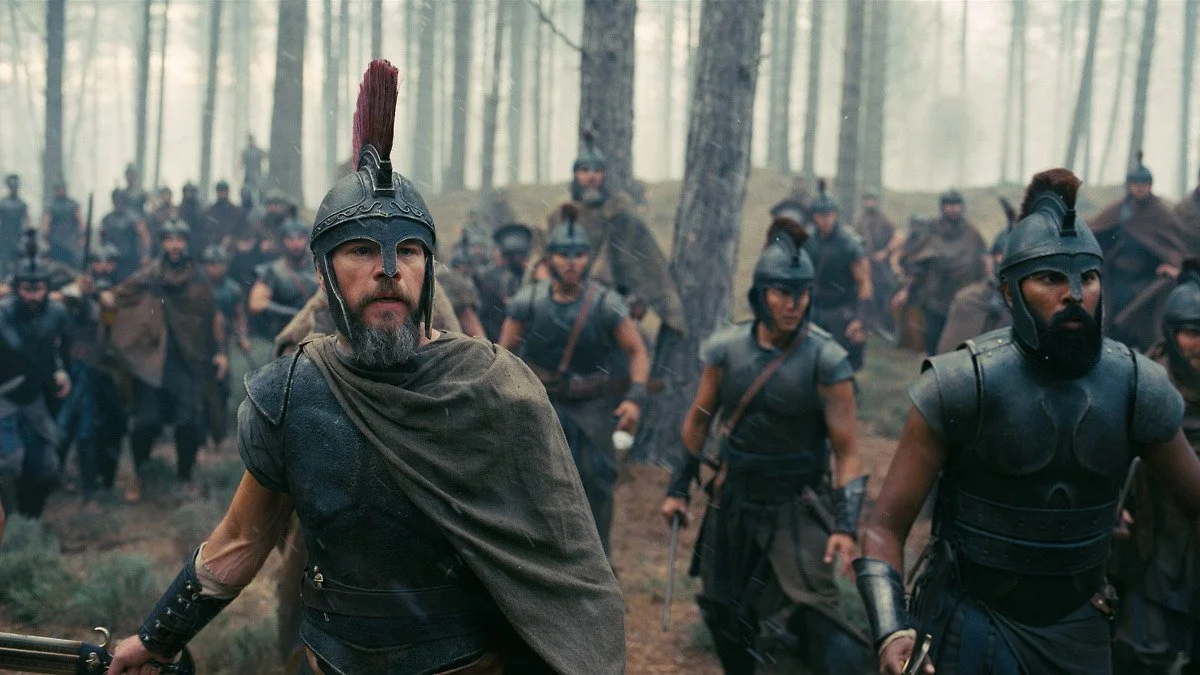
Odysseus and his men, including Himesh Patel as Eurylochus
Still, on the whole, I think this movie lived up to all the hype I gave it. The internet tried to deter me from getting excited, but I’d say the doubters were proven wrong. The Odyssey is massive, blockbuster filmmaking at its finest, and it’s another hit for Nolan and co. As far as his filmography is concerned, I’d definitely put this one up there in his top three films, maybe even ahead of The Dark Knight.
It’s especially gratifying how good The Odyssey is, given it released in a year that’s already been full of astonishing movies. Awards season next year is going to be crazy.
So, obviously, go watch The Odyssey if you haven’t already. I know I’m quite late with this review, but even as I’m writing this, it’s still doing huge numbers at the box office, so it seems like there’s plenty of time left to see it in theaters. Seriously, don’t miss out.
And now, of course, we get to sit back and wait to see what the hell Nolan and his collaborators are going to do next…