Hey there, friends. Been a while. Probably goes without saying that life’s been a bit hectic these past few months. Or has it been over a year now? Eh, either way, I’m making an effort to get back into some more consistent blogging habits.
And what better way to do that than by reviewing the final book in The Sun Eater series, Shadows Upon Time.
That’s right, at long last, author Christopher Ruocchio’s sprawling sci-fi epic comes to a close. Released back in November 2025, Shadows Upon Time is the culmination of everything that was foretold from the very beginning in Empire of Silence, plus a little extra. But did this massive finale manage to stick the landing? Maybe not perfectly, but overall, yes, I think it did.
Let’s dive in.
Of course, huge spoilers ahead!
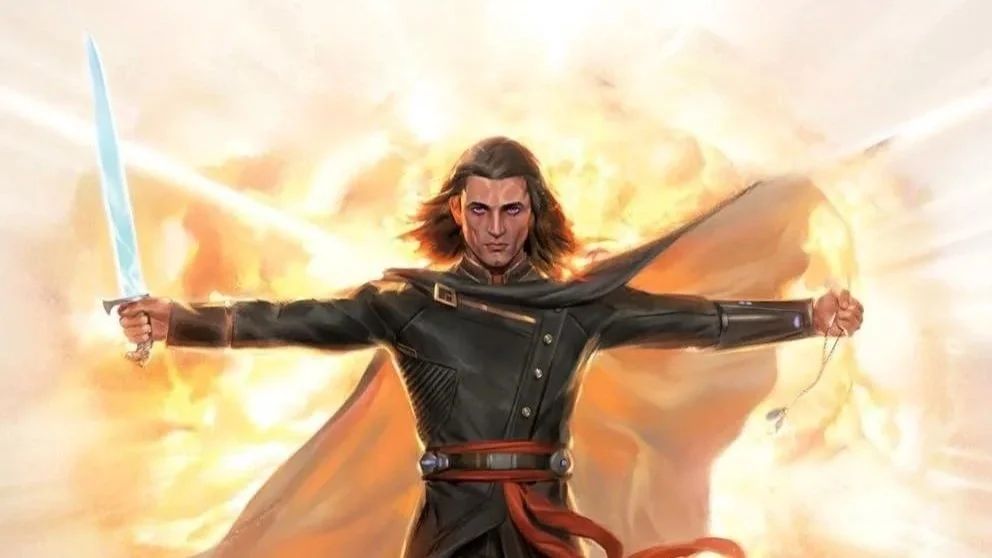
Shadows Upon Time follows Hadrian Marlowe into the twilight of the war between humanity and the alien Cielcin. His destined end fast approaches—the fated moment when he’ll destroy a sun, dooming millions of humans and the whole of the Cielcin race. But on top of battling the Cielcin and their dark gods, Hadrian must also battle the Terran Chantry and a host of other political rivals, including the Emperor’s son, Alexander. Ultimately, the fight at the end of Hadrian’s journey proves more treacherous than he could have ever imagined, and the results of that fight will change the fate of humanity forever.
This is a beefy book, putting it simply. But that makes sense, given this is the final book in the series. There’s a lot for Ruocchio to wrap up and address, most importantly giving us a fulfilling conclusion to Hadrian’s rivalry with the Cielcin prophet Syriani Dorayaica. And we finally get to see Hadrian do the thing this whole series is named after!
With so much on the line and so much to get into, you’d think the book would get off to a roaring start. But that’s not really what happens, for better or worse.
Weirdly enough, before the story really gets going, much of the beginning is spent listening to Hadrian recount events that happened immediately following the end of the previous book, Disquiet Gods. After killing Kharn Sagara and taking his gargantuan ship, the Demiurge, Hadrian then had to face off against the rest of Sagara’s forces (including a hundred or so bodies who had secretly been housing copies of Sagara’s mind, in case he was killed) and some elements of humanity’s armies. The latter of those were under orders from the Chantry to kill Hadrian and seize the Demiurge. Of course, Hadrian, his daughter Cassandra, and the rest of his comrades managed to survive the ordeal.
Having Hadrian just recount all this stuff to his closest allies felt weird to me. Not to say it’s bad, though; the action is fairly gripping throughout, and it’s followed up with a couple huge revelations, particularly that Earth isn’t actually a cold dead rock like the Chantry says it is (this is very important later on in the book). But even still, I can’t help but wonder if this would have been more effective if it were all shown to us in real-time.
In any case, once Hadrian is back in the hot seat, facing off against the Cielcin and counteracting the efforts of his political rivals (because yes, even as humanity is facing extinction, space politics and religion are still fucking things up for everyone), the story picks up quick, and it’s so damn fun.
Shadows Upon Time gives us more of what this series is already so great at. Epic space battles, grandiose worldbuilding, and clever political intrigue. And of course, Ruocchio continues with his graceful storytelling style, weaving excellent prose that both provides a clear sense of scope and scale while also lending itself to more intricate character moments.
Speaking of characters, I was particularly fond of Cassandra in this book. She was great in Disquiet Gods, but I couldn’t help but feel like her relationship with her father was oddly developed last time around. Thankfully, any gripes I had there are pretty much gone in Shadows Upon Time. We see this journey from front to back through Hadrian’s eyes, but for pretty much all of it, Cassandra is right by his side, almost to a fault (she almost dies because of it, which subsequently leads to one of the most endearing moments in the book). Events affect both of them heavily, and we get to see their development both as individuals and as a father and daughter. It’s wonderful stuff.
I was also thoroughly surprised by the Emperor and his daughter Selene. The former of the two has had an interesting relationship with Hadrian since he was first introduced in Demon in White, but he’s only gotten better with every subsequent appearance. That’s especially true for his final appearance here. I don’t know, man, something about the leader of mankind actually being a good person just hits differently (probably because I’ve been getting too deep into Warhammer 40,000 lore lately…).
And whereas Selene felt a bit passive in prior books, she has a much more active role this time around. Honestly, from the moment she first rejoins the story here, I was just so glad to have her back. She effortlessly endears herself to the rest of the core cast of characters, developing a deeper relationship with Cassandra in particular, which thus helps the romance between her and Hadrian feel all the more natural. All of the characters, really, are given their time to shine, and I’m thoroughly impressed by Ruocchio’s ability to make that happen without any of it feeling lackluster or cheap.
As expected, though, the story really picks up in the endgame. So much happens in what feels like a pretty short span of time, culminating in Hadrian defeating Dorayaica and destroying a sun, which thus also means the defeat of the dark gods known as the Watchers. This is capped off with an expertly crafted sequence of mind-bending sci-fi.
For so long, Hadrian has harnessed supernatural gifts—granted to him by his god, The Quiet—which allow him to view alternate realities and thus choose certain outcomes that help him win his battles. But this very concept is flipped on its head when, in one moment, Hadrian thinks he’s achieved victory, but in actuality, one of the Watchers is playing the cruelest of mind games with him, forcing him to relive moments of betrayal and death over and over.
Me simplifying it like this really doesn’t do justice to the sequence itself; it’s written so very well, with tight, repetitive motifs that leave you feeling as uneasy and unsure as Hadrian is in those moments. And it feels all the better once Hadrian overcomes this mental battle and defeats the Watchers for good. It’s a massive highlight for the book, no doubt about it.
But the fun doesn’t end there. In the final hours of the war with the Cielcin, and as the Emperor is nearing death, Hadrian is named the new Emperor, which opens up a whole new can of worms for our protagonist to deal with. Specifically, it means Hadrian has to take the fight to the Chantry and Alexander, who the Chantry is using as a puppet for their own designs to rule the Sollan Empire.
At the top of this review, I noted that it was “most important” for Ruocchio to wrap up Hadrian’s rivalry with Dorayaica. However, in many ways, this conflict against the Chantry might actually be more important than the one against the Cielcin.
Hadrian’s entire adventure began because he didn’t want to join the Chantry, going against his father’s wishes. And yet, ever since he first left home all those hundreds of years ago, he hasn’t quite been able to escape their shadow. Hadrian has been avoiding that cage—and many others like it—for his entire journey, and that poignant plot point is capitalized to great effect here in the final chapters of this saga.
But then, for as titanic as many of the events in this book are, it all just kind of…ends. Without a whole lot of fanfare. Alexander and the Chantry get ahold of Hadrian, and they apparently put him to death. But the way this entire series has been told, it’s been made to sound like Hadrian is in a self-imposed exile, telling us his story from some hermetic temple or something. So, you know, the ending where he dies doesn’t exactly line up.
This is, of course, done on purpose, but I’m not so sure it totally works. I think maybe some slightly more clarifying language could have been employed here to get across what’s really going on. I understand maybe wanting to leave things a little uncertain or open-ended, but it feels like we’re missing a core piece of closure to the story. After seven lengthy books, that’s not the best feeling in the world.
Furthermore, while Shadows Upon Time provides an abundance of standout set pieces moments and excellent character work, I also think it suffers from some odd pacing here and there. This kind of thing is especially egregious in the moments where various talking points are repeated or rehashed two or three different times; there are definitely a handful of conversations that maybe could’ve been simplified or rolled into one. A lot of these moments end with Hadrian having to give a big speech to a bunch of people about why he is or isn’t what people claim he is, which, while really cool, does grow a bit stale by the third or fourth time.
And yet, even with all of that being said, there is still an element of satisfaction, knowing the journey is over. Because even if the end is a little shaky and open-ended, it’s not so problematic that it detracts from everything else that was so incredible in this book and this series as a whole. As with pretty much all the books in the series, the highs really do outweigh the lows.
The Sun Eater is the first proper high sci-fi book series I’ve ever really gotten into and finished. I picked up the first audiobook back in 2024, and I’m so glad I got to go along this journey with Hadrian and his comrades over the past two years. Now, I’m just sad to see it end.
Christopher Ruocchio has crafted a true masterwork of sci-fi storytelling, and Shadows Upon Time is a critical piece in that intricate puzzle. I can only give this book—and this series—my highest recommendation.
So, thank you, Christopher Ruocchio, for writing this series. And thank you, dear readers, for checking out this review.
If you’d like to see the rest of my reviews for the Sun Eater series, you can find them below.